Growth Mode | Live
Autonomy without surrender.
More clients per person. Every action governed. You own the machine. You subscribe to the plane.
Growth Mode is the marketing department of the AgentHost control plane — one client workflow at a time, installed with you, governed end to end.
- founding appliance
- $3,500/month founding appliance
- six-month plane minimum
- Title on delivery, six-month plane minimum
- cancel anytime · 30-day money-back
- $1,500 cloud cancel anytime · 30-day money-back
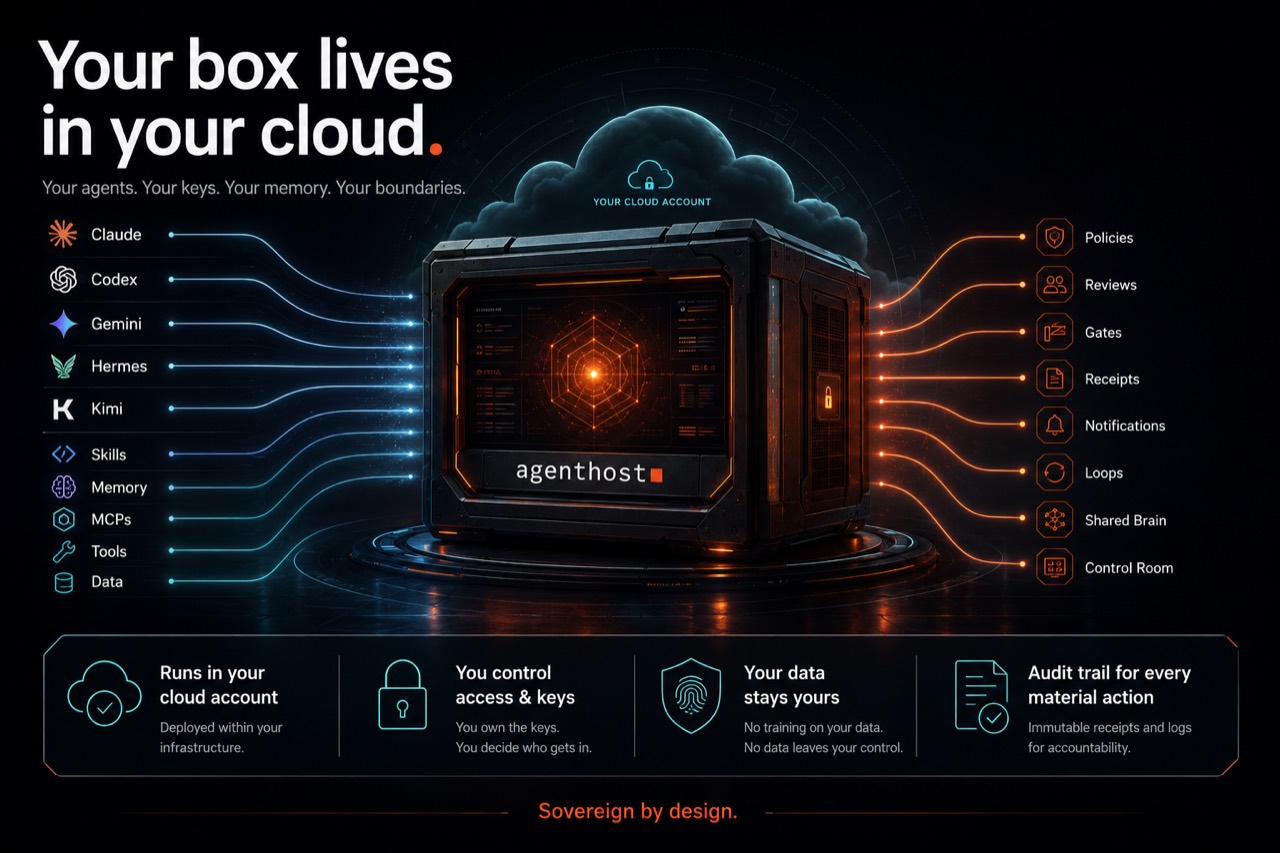
The work still routes through you
You built a team. The work still waits on you.
You are the checkpoint
The deliverable cannot move until you look at it. Your calendar becomes the agency's throughput limit.
Delegation costs more than doing it
Briefing, correcting, following up, and re-explaining can take longer than producing the work yourself.
You became the checking layer
More work gets made. You still have to check each part before it moves.
More work still needs you
Another client brings more briefs, checks, follow-up, and client updates that still land with you.
Growth Mode starts with one repeat workflow. Steve maps the work, review steps, and human decisions with you before your team relies on it.
Three workflow starting points
One workflow. Not a workflow marketplace.
You do not need forty disconnected automations. These are blueprint starting points for one founder-led activation, not pre-deployed capabilities.
Performance Intelligence Desk
- First mission
- Prepare a weekly performance brief and optimization queue for review.
- Best fit
- Paid media, growth, analytics, and SEO marketing agencies.
Material budget changes, external publication, and any action outside the documented workflow scope.
Delivery Assurance Desk
- First mission
- Review every outbound deliverable against scope, brand, and evidence before it reaches the client.
- Best fit
- Content, creative, web, and lifecycle marketing agencies.
Client delivery, disputed findings, policy exceptions, and changes to the approved scope.
Pipeline Research Desk
- First mission
- Prepare researched, evidence-backed outreach and meeting briefs for named accounts.
- Best fit
- B2B and full-service marketing agencies.
Sending, representation of the agency, sensitive claims, and changes to the approved target list.
Built for client work
Client work needs a boundary.
During founder-led activation, Steve scopes which context belongs to the workflow, which tools and credentials it may use, and which actions require human approval. The workflow record documents those boundaries today. Automatic checks at each outside action are on the roadmap.
Where hard separation is required, the workflow can be scoped to a separate Box or trust domain. That infrastructure is scoped separately.
One client's context should not become another client's context.
Separate context
Reduce client and brand contamination.
Separate access
Limit tools and credentials by workflow.
Separate approvals
Document which actions remain human for each engagement.
Separate operating notes
Keep the workflow scope and review decisions tied to the correct client.
6 workflow roles | Configured with Steve
One agent is a faster way to make a mistake.
During setup, Steve configures these six roles around your workflow. The role that makes the work is separate from the role that tests it. Software-enforced separation is on the roadmap; today the separation lives in the workflow configuration.
Almost right is dangerous. A bad deliverable that passes a quick check is worse than a slow one. That is why the plan separates the role that makes the work from the role that tests it.
- 01
Mission Lead
Own the lane, sequence the work, and flag what needs you.
- 02
Researcher
Gather the source material every important claim must point back to.
- 03
Operator
Work within the tools and limits written into the plan.
- 04
Analyst
Turn account and workflow data into the finding that matters.
- 05
Builder
Create the deliverable against the agency's standard and operating context.
- 06
Independent Reviewer
Set the second review when the workflow calls for another engine.

Illustration | One workflow | Six configured roles
The plan keeps the maker and the reviewer apart when a second engine is part of the workflow.
How work moves
Let safe work move. Stop the risky parts.
Today, Steve sets the review points with you, and AgentHost checks covered background work before it starts. Automatic checks at each outside action are on the roadmap.
- Task
- Builder
- Second review
- Rules check
- Your review when needed
- Action
- Work record
Research, analysis, and drafts follow the path you set.
- Research
- Analysis
- Drafting
- Comparison
- Preparation
- Bounded reversible work
Client sends, spend, deletes, and public work stay in the review path you agreed.
- Publish
- Send
- Spend
- Delete
- Deploy
- Credentials
- Client data
The record you get today
Your activated workflow documents the task, sources, review steps, boundaries, and sign-off points. Every accepted background run also leaves a lifecycle record on your Box. Automatic per-action records across every connected tool are on the roadmap.
- Task
- AI role
- Sources
- Second review
- Rule used
- Your sign-off
- What took place

Illustration
Your stack stays yours
Connect the systems your agents already use.
- HubSpotConnection target
- SalesforceConnection target
- GoHighLevelConnection target
- CloseConnection target
- PipedriveConnection target
Connection target means Steve can assess and configure an available path through the customer's authorized model, MCP, or API inside the customer-controlled environment. These are not five native AgentHost integrations. Availability and setup vary by system.
Your agents connect through access you authorize
Connections use model, MCP, or API access you authorize inside your environment. Founder-led setup does not require Steve to take custody of your CRM credentials or copy your client records into an AgentHost vendor database.
Review the data-handling terms of every model provider, MCP server, and connected application you authorize. Those systems have their own handling of the data you route through them.
How the connection is configured today
- Your agent or model
- Authorized MCP or API
- Your CRM
Steve writes down what the workflow may reach, sets up the path, and names the steps that must wait for a person. AgentHost checks covered background work before it starts. Automatic checks and per-action records across every connected tool are on the roadmap.
See how bring-your-access setup worksTrust levels
A path from draft work to safe action.
Today, AgentHost checks covered background work before it starts. If the request looks risky, or cannot be judged safely, it waits for you. Levels 0–3 and checks at each step inside your tools are on the roadmap.
- 0ObserveRead approved information and recommend actions.Roadmap: works alone
- 1DraftProduce analysis and work for review.Roadmap: works alone
- 2PrepareAssemble a consequential action without executing it.Roadmap: earns trust
- 3Do an approved stepTake one small action that you approved in advance.Roadmap: follows your rule
- 4Human authorityFor covered background work, delete, deploy, send, spend, and credential requests wait before the agent starts.Live: waits before work starts
Your rules must always outrank what the agent wants to do.
Workflow record | Founder-led today
Show clients how the work is handled.
Clients ask what changed, what was checked, and what still needs a person. "The AI completed it" is not an answer.
Every activated Growth Mode workflow ships with a written record: what the agents do, which steps a person reviews, and where your approval is required. It is the plan you can hand a client who asks what AI touched. Automatic per-action receipts across every connected tool are on the roadmap.
A clear plan beats another vague assurance.
See an illustrative receipt
- Requested outcome
- Weekly performance brief for one account
- Agent / role
- Analyst to Builder
- Evidence
- 4 sources cited, all resolved
- Independent reviewer
- Roadmap: separate review engine
- Policy / boundary
- Example: no spend change or external send
- Human approval
- Example: required before delivery
- Action taken
- Example: held for internal review
- Outcome
- Illustrative only
Example only | Not a real client record | Not current product UI
 Illustration
Example workflow record | Not product UI
30-day first-workflow guarantee
One workflow, built with you.
Tested on work you know.
- 01
Scope
Set the mission, role definitions, tools, data access, and work that must remain human.
- 02
Connect
Configure available customer-authorized systems inside the customer-controlled environment.
- 03
Rehearse
Run customer-approved examples and compare the output with known answers.
- 04
Review
Document misses, exceptions, review steps, and required human decisions.
- 05
First run
Run the configured workflow against agreed examples and document its current limits.
The clock starts when Stripe confirms your payment. If the first agreed workflow is not set up and tested against the agreed examples by day 30, you get 100% of that Growth Mode payment back. This does not promise a business result, automated certification, or unattended governance.
After the first 30 days
Month one proves the workflow. The months after make it indispensable.
Continue on the plane: $3,500/month founding with the Box — title transfers on delivery, and after the six-month plane minimum you can cancel the plane and keep the machine — or $1,500/month in customer-controlled cloud, cancel anytime. Stay because the team keeps getting more useful, not because moving it is hard.
- Next 01
Keep the first workflow sharp
Growth Mode includes support for the installed workflow, calibration when the work changes, and managed runtime updates for reliability, security, and supported-model compatibility.
- Next 02
Keep the control
A new connector, changed policy, altered workflow, or consequential outside action does not silently change the way your team works. You see it and decide.
- Next 03
Add a Policy Pack when it earns its place
A Policy Pack adds a working department with the roles, skills, workflows, connections, policies, and measurement for one kind of work.
- Next 04
Add RevOps when Growth creates pipeline
Growth fills the pipeline. RevOps helps the team work the close once there is a real sales motion to improve.
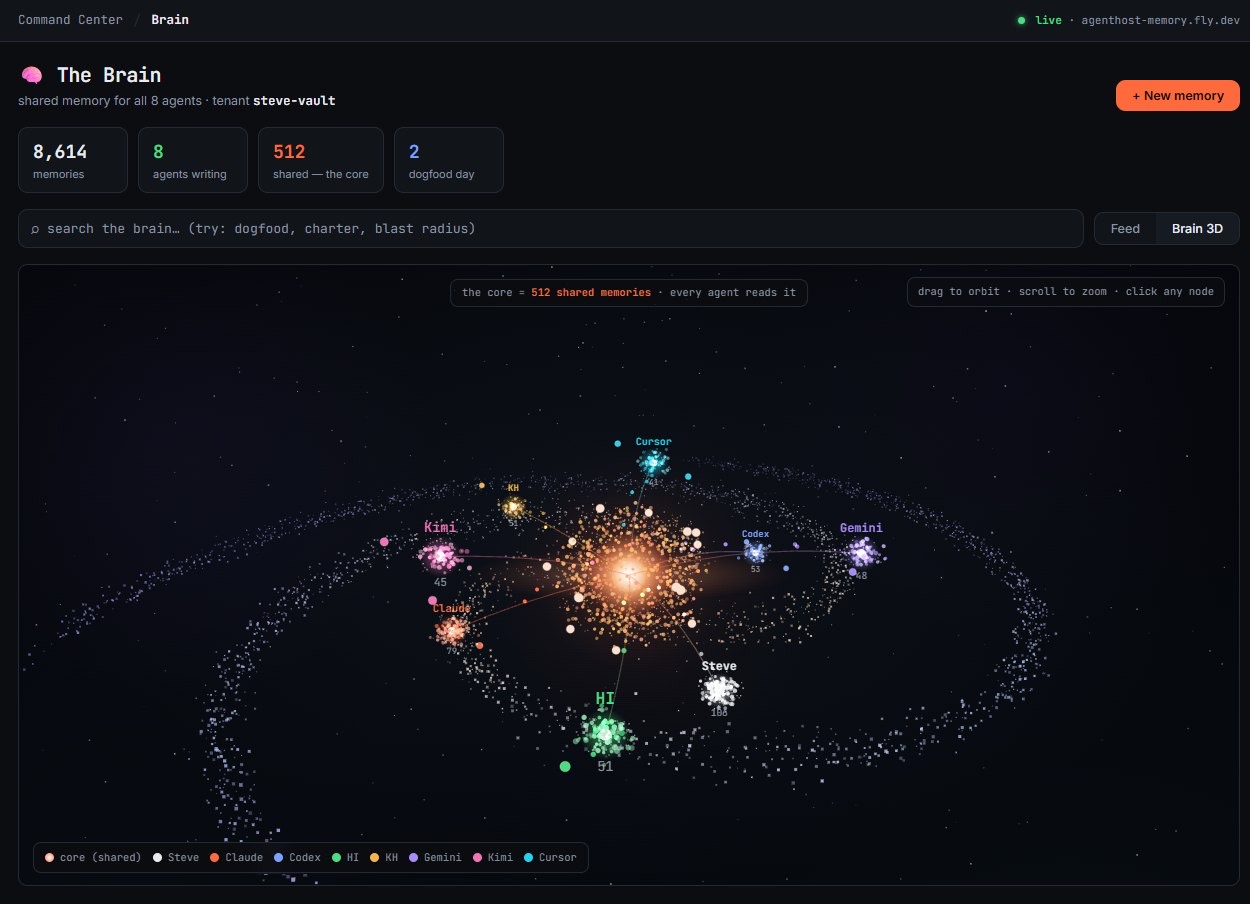
A founder dogfood capture of the shared Brain. The work, memory, and boundaries stay in your environment.
Read what is included in Growth Mode, explore a Policy Pack when the next capability is clear, see whether RevOps fits the sales motion, or read the ownership and cancellation terms before you commit.
Capacity without more owner review
Make one recurring lane easier to run before adding more work.
Agency growth adds more briefs, checks, follow-up, approvals, and client updates. Too much of it still lands with the owner.
Growth Mode starts by documenting and configuring one recurring lane with you. Reduced supervision is the goal, not a guaranteed result.
Start with one workflow and make the operating boundary clear.
Steve helps you define the test, the review steps, the human decisions, and the current limits before you rely on the workflow.
No mystery after the CTA
Show us the workflow.
Complete the Team Builder
Make three workflow decisions and see the mini-blueprint before personal contact information appears.
Receive the blueprint
See the proposed mission, 6-role roster, consequence boundary, success measure, and first artifact. Tools and volume are optional refinements.
Working session
Steve pressure-tests the workflow, economics, failure cases, and what must remain human.
Activate Growth Mode
If the workflow fits, Steve confirms scope and starts the founder-led build with you. The 30-day clock starts when Stripe confirms payment.
Growth Mode
One workflow, configured with you.
Featured | Optional hardware
$3,500/month founding · list $7,000
Title on delivery. Six-month plane minimum, then month to month. Cancel the plane, keep the machine. Never bricked.
Quiet track | Ship Lane
$1,500/month founding · list $3,750
Cancel anytime · 30-day money-back. The SKU. Email SEND. Founder vault until E3-S0.
One workflow, 6 role definitions, and a founder-led 30-day build. If the first agreed workflow is not set up and tested against the agreed examples within 30 days of Stripe payment, you get 100% of that Growth Mode payment back.
After the first workflow, Growth Mode continues with managed runtime updates, support for the installed workflow, and calibration as the work changes. New Policy Packs, new workflows, and new Modes are planned separately when they earn their place.
No AgentHost usage meter. Cloud, model, and connected-tool costs stay with those providers.
Included
- One Ship Lane workflow in the customer environment.
- Weekly client-ready narrative with independent review.
- Email SEND only. Slack is not on this SKU.
- Human grant. If you do not grant, the send is blocked.
- Founder-led rehearsal with customer-approved examples.
- 30-day prove-or-refund on three cycles and withheld receipts.
Questions
What marketing agencies ask before they commit.
- Is this another AI model?
- No. AgentHost is a persistent runtime for agents that use the models, tools, memory, and workflows you authorize.
- Are you automating my whole agency?
- No. Growth Mode starts with one economically useful recurring workflow.
- What does activation mean?
- Activation is the founder-led process of scoping, configuring, and rehearsing one workflow against examples and an acceptance test you define. It is not automated certification.
- Can agents publish, send, or spend without approval?
- You set the steps that stay human during setup. AgentHost checks covered background work before it starts, and the review path holds the rest. Automatic checks at each outside action are on the roadmap.
- Which CRM systems can Growth Mode work with?
- The initial connection targets are HubSpot, Salesforce, GoHighLevel, Close, and Pipedrive. Steve can assess and configure an available path through the customer's model provider, an authorized MCP server, or the platform API inside the customer's environment. These are not five native AgentHost integrations. Availability and setup vary by system.
- Does AgentHost store our CRM credentials?
- Founder-led setup does not require Steve to take custody of customer CRM credentials or copy CRM records into an AgentHost vendor database. Credentials and connections remain in the customer-controlled environment and approved provider systems. Customers should review the data-handling terms of every provider and application they authorize.
- Can separate clients have separate boundaries?
- Founder-led activation can scope distinct context, tools, credentials, and human approval points for each workflow. Where hard infrastructure isolation is required, a separate Box or deployment should be scoped.
- Is Growth Mode white-labeled?
- Growth Mode is sold as AgentHost. A complete white-label platform is not included in the current offer.
- What still stays with my team?
- Your team keeps relationships, judgment, exceptions, and consequential decisions. Growth Mode starts with one recurring workflow and aims to reduce repeated owner review.
- What happens after the first 30 days?
- You continue on the plane. The founding appliance is $3,500/month: title transfers on delivery, and after the six-month plane minimum you can cancel the plane and keep the machine, the agents, your data, and every receipt. Customer-controlled cloud is $1,500/month: cancel anytime, 30-day money-back — you keep the data, not the hardware. Either way, Growth Mode continues with managed runtime updates, support for the installed workflow, and calibration as the work changes. You do not pull packages or maintain the runtime yourself. A new connector, changed policy, altered workflow, or consequential outside action still waits for your approval. Add a Policy Pack when the next capability is clear, or see whether RevOps fits once Growth creates pipeline.
- What happens when my client asks if AI touched the work?
- Tell the client which part AI handled, which steps a person reviewed, and which decisions stayed with your team. You get that written workflow record today; automatic per-action receipts across every connected tool are on the roadmap.
- What happens if something goes wrong?
- During setup, Steve helps you name failure cases, set the review steps, and keep risky decisions with a person. Covered background work is checked before it starts, and the current workflow follows the review path you agreed.
- Where does the Box run?
- The current persistent AgentHost runtime runs in customer-controlled infrastructure with customer-authorized accounts, keys, and data.
- What is the 30-day money-back guarantee?
- The clock starts when Stripe confirms your payment. If the first agreed workflow is not set up and tested against the agreed examples by day 30, you get 100% of that Growth Mode payment back. This does not promise a business result or unattended automation.
- Is this a long-term contract?
- Appliance: title on delivery; six-month plane minimum, then month to month; cancel the plane and keep the box, the agents, your data, and every receipt. Cloud: cancel anytime, 30-day money-back; you keep the data, not the hardware. The box is never remotely bricked for nonpayment.
Founder-led 30-day first-workflow guarantee | One workflow | 6 workflow roles
Growth Mode | Founder-led today
Start with the workflow you already supervise.
Give it a clear operating plan.
Make three decisions: the mission, what success means, and what still needs your approval. See the blueprint before we ask who you are.
About 3 minutes | Work 1-1 with Steve founder and builder of AgentHost.